
ScopeItOut: Tomorrow Can’t Wait
ScopeItOut: Tomorrow Can’t Wait
Why Colon Cancer Screening Matters
The Most Important Facts That Can Save Lives
1. Colorectal cancer is rising in younger adults – Colorectal cancer is now the leading cause of cancer-related death in people under age 50. Rates in younger adults have steadily increased over the past two decades. Many younger patients are diagnosed at later, more advanced stages.
2. Colon cancer is one of the most preventable cancers – Colonoscopy can detect cancer early. Even more importantly, colonoscopy can prevent cancer by removing precancerous polyps.
3. Most people who get colon cancer have no family history – Most patients diagnosed do not have a family history. Being “average risk” does not mean no risk.
4. Colon cancer often has no early symptoms – Do not wait for symptoms. When symptoms appear, cancer may already be advanced. Possible symptoms may include:
- Rectal bleeding
- Change in bowel habits
- Unexplained anemia
- Abdominal pain
- Unexplained weight loss
5. Screening should start at age 45 – The American Cancer Society recommends screening starting at age 45. Earlier screening may be needed for higher-risk individuals.
6. You have the right to choose your gastroenterologist – Patients have the right to choose where they receive their colonoscopy. You may request Shenandoah Valley Gastroenterology Center when speaking with your primary care provider regardless of what system they work for. Timely access to screening can make a life-saving difference.
7. Why choose Shenandoah Valley Gastroenterology Center – With over 15 years of high-quality care in the Shenandoah Valley, we focus on patient comfort, safety, and quality outcomes. We are dedicated gastroenterology specialists and experienced staff. Our commitment is to your timely access to screening and prevention.
8. Don’t delay screening – Long waiting lists may delay important preventive care. Patients may request referral to Shenandoah Valley Gastroenterology Center rather than waiting an extended period. Early screening helps prevent cancer before it develops.
9. Understanding stool-based tests like Cologuard – When depending on a stool-based screening test such as Cologuard, it is important to understand:
- These tests can have false-negative results.
- A negative result may provide a false sense of security.
- Colonoscopy remains the gold standard for prevention and detection.
- If a negative stool-based test is performed and later you choose to do a colonoscopy because your learned about false negative results, insurance may not pay for the screening colonoscopy as you have already used your screening benefits.
- Coverage may change depending on you carrier.
Patients are encouraged to discuss screening options carefully with their healthcare provider to determine the best approach.
What You Can Do Today
- If you are 45 or older — schedule a screening today.
- If you are under 45 — know your symptoms and risk.
- Encourage parents, family, and friends to get screened.
- Speak with your primary care provider.
- Request Shenandoah Valley Gastroenterology Center if you prefer timely, high-quality care.
Tomorrow Can’t Wait
Colon Cancer Screening Saves Lives
Prevention Starts With You
ScopeItOut — Tomorrow Can’t Wait
Shenandoah Valley Gastroenterology Center, PLLC
Celebrating 15 years! 2011 – 2026
High quality | comfort | safety
info@svgastro.com
(540) 437-0087
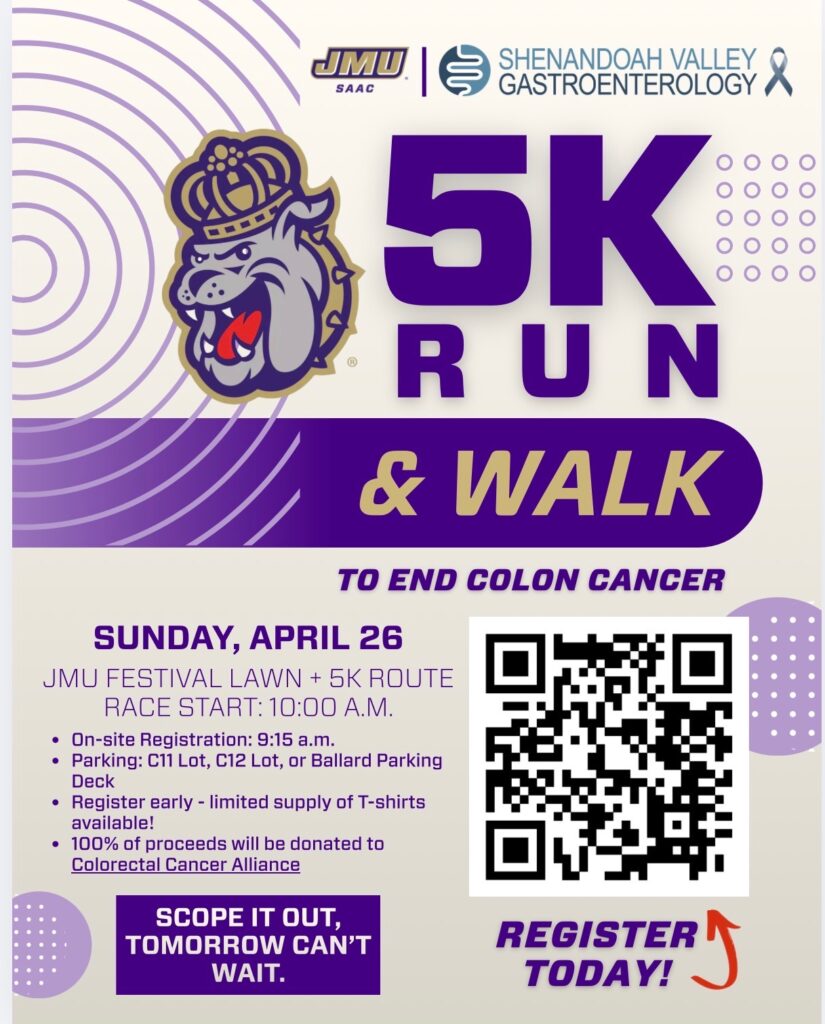
Shenandoah Valley Gastroenterology Center and JMU Athletics Announce “ScopeItOut: Tomorrow Can’t Wait” Dukes 5K to promote colorectal cancer prevention and awareness.
Shenandoah Valley Gastroenterology Center, PLLC, in partnership with JMU Athletics, announces the “ScopeItOut: Tomorrow Can’t Wait” 5K Walk/Run on April 26, 2026, at James Madison University in Harrisonburg, Virginia. Registration is encouraged to be done online. You could also scan the registration QR code on site beginning at 9:15 AM at the Festival Lawn, with the race starting at 10:00 AM. Free parking will be available.
The event focuses on colon cancer prevention and the alarming rise of colorectal cancer in adults under age 50. According to the American Cancer Society, colorectal cancer is now the leading cause of cancer-related death in people under 50, with rates continuing to increase in younger adults.
The troubling trend Is steadily rising:
- Incidence among Americans ages 20 to 39 is projected to increase by 90% by 2030
- Every day, nearly 60 Americans in their 40s or younger are diagnosed with colorectal cancer
- That is equivalent to one diagnosis in young people every 25 minutes
Colon cancer is one of the most preventable cancers, yet many cases occur in individuals without symptoms or family history. Most patients diagnosed with colorectal cancer do not have a family history, making screening especially important. The American Cancer Society recommends screening beginning at age 45, with colonoscopy considered the gold standard because it allows physicians to detect and remove precancerous polyps before cancer develops.
“Prevention is the most powerful tool we have,” says Dr. Javier Pou of Shenandoah Valley Gastroenterology Center. “We encourage average-risk individuals to begin screening colonoscopies at age 45. For those under 45, it is important to understand that colorectal cancer is rising in younger adults, to consult their healthcare provider if symptoms occur, and to recognize that colonoscopies prevent cancer at any age.
Tomorrow can’t wait when it comes to prevention.”
Event Details
Event: ScopeItOut: Tomorrow Can’t Wait 5K
Date: April 26, 2026
Location: James Madison University Festival Lawn Registration: 9:15 AM
Race Start: 10:00 AM
Parking: Free parking in C11 Lot, C12 Lot, and Ballard Parking Deck. Best accessed through Reservoir Road and University Boulevard.
The event will include a 5K run/walk, participation from JMU student-athletes, educational resources, and a family-friendly community atmosphere. Proceeds will benefit the Colorectal Cancer Alliance to support awareness and screening initiatives.
Community members, patients, students, and families are encouraged to attend and support the mission of preventing colorectal cancer through early detection and education.